
Cypress Wood Flooring has handled hardwood floor repair for more than 20 years in Cypress, CA, serving surrounding cities including Los Alamitos, Hawaiian Gardens, La Palma, Stanton and Buena Park. We replace damaged boards, stop squeaks, repair termite and pet damage, secure loose planks and fix the subfloor problems that cause many surface symptoms.
A repair only lasts when the cause is fixed along with the damage. A cupped board, a soft spot or a black stain is a symptom, and replacing the wood without tracing the moisture, loose fastener or failed subfloor behind it simply moves the problem into new boards. That is why every repair starts with a diagnosis, not a saw.
Most of our repair work is in houses where the owner has lived for years and wants to keep the floor they have, not replace it. Our aim is a repair you cannot find afterward: matched species, matched width, boards woven into the existing pattern and a finish blended to the room.
Diagnosing What Is Wrong With the Floor
Cupping, Crowning and Buckling
When board edges rise higher than the centers, the floor is cupping, usually because moisture is reaching the underside. Crowning is the opposite, and often appears after a cupped floor was sanded flat too soon. Buckling, when boards lift away from the subfloor entirely, points to a serious moisture event or a missing expansion gap.
We measure moisture content across the floor with a wood moisture meter and compare wet and dry areas. The pattern tells us where the water is coming from, whether a leak, a crawlspace, a concrete slab or a spill, so the repair plan addresses the source before any board is replaced.
Squeaks, Soft Spots and Movement
Squeaks usually come from boards rubbing where fasteners have loosened, or from a subfloor that has separated from the floor joists. Soft spots are different: a floor that gives underfoot, especially near a toilet, tub or sliding door, often means the plywood subfloor beneath has been wet and is breaking down.
We track a squeak to its source and secure the floor, and we treat a soft spot as a subfloor question before a flooring one. Pricing a new surface without checking the plywood underneath would be guessing, and new boards installed over failing subfloor start squeaking and sagging again quickly.
Gaps Between Boards
Solid wood swells and shrinks with humidity, so board gaps open in drier months and close later. Those seasonal gaps are normal and filling them usually fails, because the filler cracks out when the boards swell again. Gaps that stay open all year, or that grow, are a different matter and may need board replacement.
For wide permanent gaps, we can glue thin slivers of matching wood into the openings and sand them flush, which holds far better than putty. Where many boards have shrunk or loosened across a room, the better fix may be relaying that section, and we explain the difference in cost and result before you decide.
Board-Level Repairs
Board Replacement and Weave-In Repairs
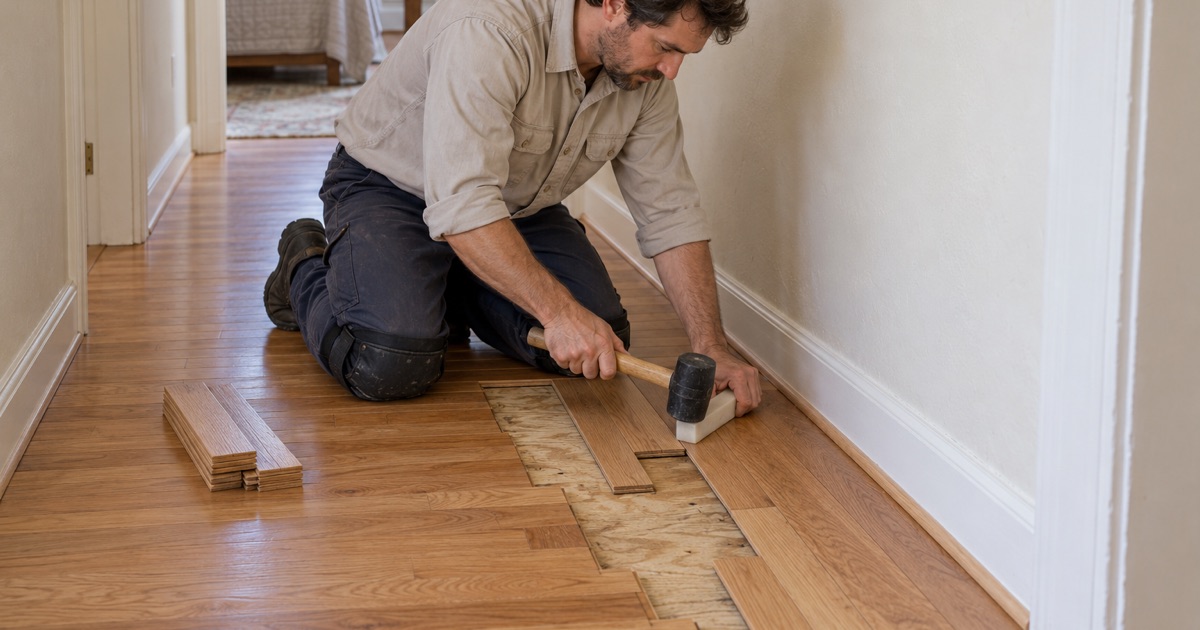
A damaged board is cut out along its length, and a new one is fitted by removing the bottom of the groove so it can drop into place and be glued and fastened. For larger areas, we remove boards in a staggered pattern and weave in new ones, so there is no straight seam that shows where the old floor ends.
Matching matters as much as technique. We identify the species, measure width and thickness, and look at grain and age. Red oak, white oak, maple and hickory each take finish differently, and a board of the right species but the wrong cut can still stand out once finished.
Pet Stains and Water Marks
Pet urine stains that have soaked into oak react with the wood’s tannins and turn dark, and they often go too deep to sand out. The same goes for black rings where water sat for a long time. We sand a test spot, and where the stain remains, we replace the affected boards rather than leave a shadow under new finish.
Odor is part of the problem with old urine damage. When a smell persists, the subfloor under the stain may be affected as well. We check it when the boards come up, and seal or replace the plywood where needed, so the repaired floor does not bring the smell back on the first humid day.
Engineered Veneer Delamination
Engineered planks can lose their top layer, called veneer delamination, from moisture, adhesive failure or wear. Individual planks can be replaced with matching stock, and where the product is still available, the repair can be nearly invisible. If it is discontinued, we look for the closest match and may relocate boards to less visible areas.
Before replacing delaminated planks, we find out why the veneer failed. If moisture from a slab or a leak caused it, new planks will fail the same way unless that source is dealt with first, so we take readings and check the adhesive bond around the damaged area before ordering replacement stock.
Termite, Beetle and Structural Damage
Drywood Termite Damage
Drywood termites live inside the wood they eat, and signs include small, hard pellets called termite frass, hollow-sounding boards and tiny holes. After treatment, including termite fumigation where needed, we remove damaged boards, check nearby boards and the subfloor, and replace what is weakened.
Tenting itself does not harm a finished floor, but damage revealed after treatment often extends beyond the obvious spots. We probe the surrounding boards and look at the subfloor from underneath where access allows, so the repair covers all the weakened wood rather than just the boards with visible holes.
Powderpost Beetles
Powderpost beetles leave small, round exit holes and fine, flour-like dust, and they tend to favor certain hardwoods. We identify the damage, recommend treatment by a pest professional where activity is ongoing, and then replace boards that have lost their strength with matched stock.
Not every small hole means active beetles, since old exit holes can remain in wood for many years after the insects are gone. Fresh, pale dust below the holes is the usual sign of current activity. Telling the two apart keeps you from paying for treatment or replacement the floor does not need.
Subfloor and Joist Problems
Some floor problems start below the flooring entirely. A plywood subfloor that has delaminated from moisture, or a floor joist that has sagged or split, will keep damaging the finish floor above it. We open up the floor as needed, repair or replace the subfloor, and work with a structural specialist when joists need attention.
The repair order matters: we fix the structure first, confirm it is dry and flat, and only then reinstall and blend the finish floor. Skipping ahead to the visible surface may look quicker, but it leaves the root cause in place under brand new boards.
Finishing the Repair So It Disappears
Spot Finishing or Refinishing the Room
A small repair can sometimes be spot-finished and blended, especially on a floor with a matte or satin finish. For larger repairs, or floors with an aged finish, the best match comes from sanding and refinishing the whole room together, which evens out color and sheen across old and new boards.
We discuss both options before starting, with the likely result of each. Every finish we use is legal in the South Coast air basin under the 275 g/L VOC limit of SCAQMD Rule 1113, whether it is a waterborne product, an oil-modified polyurethane or a hardwax oil.
Older Homes and Safe Work Practices
In pre-1978 housing, repairs that disturb painted baseboards or shoe molding follow the lead-safe practices of the EPA Renovation, Repair and Painting rule. Where old tile or black mastic is involved, it is treated as an asbestos question and tested before anything is disturbed.
These precautions add a step to some repairs, but they protect the people living in the house, especially children and older residents who spend much of the day at home. We explain up front when a repair falls into one of these categories, so the extra step is part of the plan and the price rather than a surprise.
- 20+ Years in Wood Flooring
- Moisture Readings in Writing
- Room-by-Room Cure Schedule