
Cypress Wood Flooring has repaired hardwood floor water damage for more than 20 years in Cypress, CA, serving surrounding cities including Los Alamitos, Hawaiian Gardens, La Palma, Stanton and Buena Park. We rebuild wood floors after slab leaks, burst supply lines, water heater failures, appliance leaks and AC condensate overflows, once the water has been stopped and the structure has been dried.
Water damage to a wood floor is a sequence, and the order is what decides whether the repair holds. The leak is found and fixed first, then the structure is dried, then the moisture is confirmed with readings, and only then is the floor rebuilt. Skipping or rushing any of those steps is how a new floor ends up cupped within months.
We document each step as we go, with photos and moisture readings an insurance adjuster can use, and we write a scope that explains which boards must be replaced, which can be saved, and how the repaired area will be matched to the rest of the floor.
Where the Water Comes From
Slab Leaks Under the Floor
In houses built on a concrete slab, water and sometimes hot water lines run through or under the concrete. When one of those lines fails, water rises through the slab and into the flooring from underneath. Common signs include a warm spot on the floor, boards cupping in one area, a musty smell or a sudden rise in the water bill.
Once leak detection has located the break, the plumber either repairs the line through an opening in the slab or reroutes it through walls or the attic, sometimes as part of a wider repipe. We talk with the plumber before any boards are cut, so the access opening sits where it causes the least damage to the floor around it.
Appliance Supply Lines
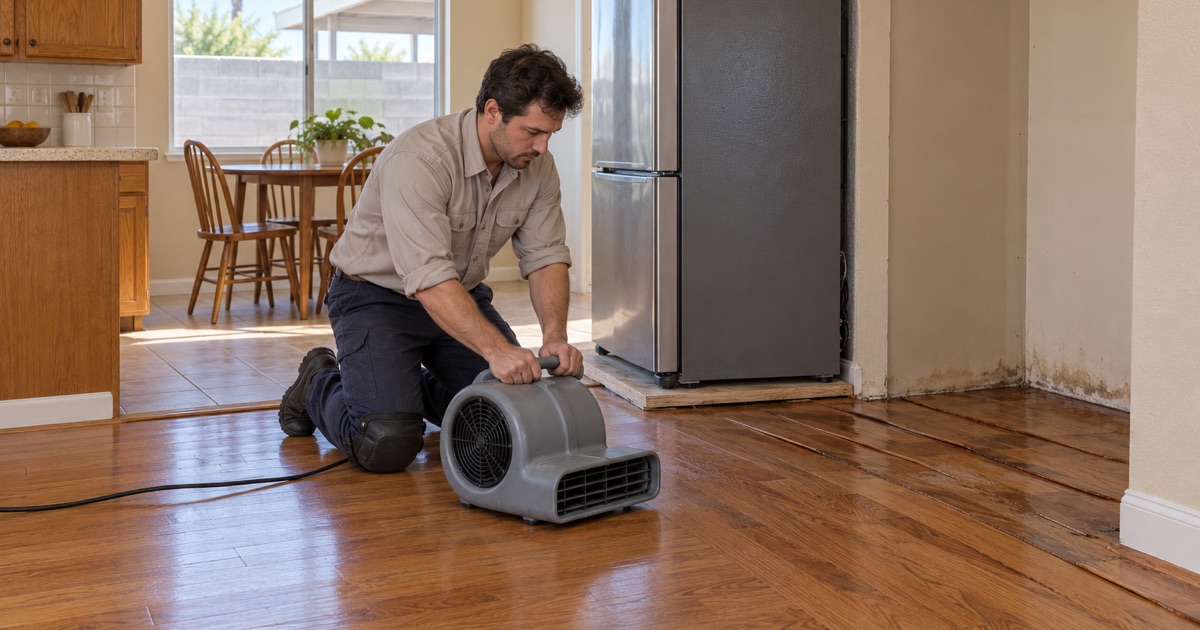
A dishwasher supply line or refrigerator water line can drip for weeks behind or beneath an appliance before anyone notices. By the time the floor cups at the edge of the cabinet, water has usually spread under the boards well beyond the visible damage. Braided lines that have aged and plastic icemaker tubing are frequent sources.
We pull the appliance, take moisture readings outward from the source until the numbers return to normal, and mark the boundary of the damage on the floor. That boundary, not the visible stain, decides how much of the floor needs attention and gives the adjuster a clear picture of the loss.
Water Heaters and AC Condensate Lines
Water heaters often sit in garages or closets next to finished rooms, and a failing tank or relief valve can soak nearby floors. An AC condensate line that clogs can back up and overflow slowly, especially from an air handler in a closet or attic, sending water down walls and under baseboards.
These leaks tend to affect floors at the edges of rooms, along walls and in closets, where damage is easy to miss. We check under baseboards and shoe molding and read the moisture in walls where they meet the floor, so the full extent of the damage is known before any repair is scoped.
Assessing and Documenting the Damage
Reading Moisture, Not Just Looking
The surface of a wood floor can look dry while the underside and subfloor are still wet. We use a wood moisture meter on the boards and take readings of the subfloor or slab, comparing wet areas to unaffected parts of the same floor, which gives a baseline for what dry means in your house.
Readings are taken over several visits when needed, because wood dries slowly and a single good number can be misleading. Only when the affected area matches the baseline do we make final decisions about which boards to keep, which to sand and which to replace.
Cupping, Crowning and Buckling After a Leak
Cupping is the most common response to water: board edges rise as the underside swells. As the floor dries, many cupped boards settle back toward flat. Buckling, where boards lift from the subfloor entirely, is more severe, and those boards usually need to come out.
Crowning, where the center of each board is higher than its edges, is often a sign that a cupped floor was sanded while still wet. We avoid it by waiting for the readings, and where a previous repair has left a crowned floor, we explain what can still be done.
Photos and Records for the Claim
We photograph the damage, the moisture readings and each stage of the work, and record the flooring’s species, width, thickness and finish. That information helps an adjuster understand what was damaged and what it will take to restore the floor to its prior condition.
California’s fair claims regulations, including 10 CCR 2695.9, set standards for how insurers handle the repair or replacement of damaged property. We do not negotiate your claim, but our documentation gives you and your adjuster the facts about matching and scope, so decisions are based on the actual floor rather than on assumptions.
Rebuilding the Floor
Repairing the Subfloor First
Water that sits under a wood floor often damages the plywood subfloor, causing it to swell, delaminate or lose its grip on the fasteners. Soft spots near where the leak started are common. We replace damaged subfloor sections and secure them to the floor joists before any new flooring goes down.
On a slab, the concrete itself needs to dry before a new floor is glued to it. We test it with a calcium chloride moisture test or an ASTM F2170 in-situ relative humidity test and write the readings down, so the new floor is installed on a slab that meets the manufacturer’s limits.
Closing a Slab Leak Access Opening
After a slab leak repair, the plumber leaves an opening in the floor that has been patched in concrete. We check that the patch is flat, cured and dry, then rebuild the finish floor across it. For a wood floor on a slab, that usually means engineered planks glued down or floated over a vapor retarder.
Where possible, we save undamaged boards around the opening and weave replacement boards into them, so the repair does not leave a visible rectangle. The goal is a floor that reads as one surface again, with no trace of the access point.
Weaving In and Refinishing
Replacement boards are woven into the existing floor with staggered joints, never butted along a straight line. Solid floors are then sanded and refinished, usually across the whole room, so old and new boards take the same stain and sheen.
Finishes are chosen from products legal in the South Coast air basin under the 275 g/L VOC limit of SCAQMD Rule 1113. When the floor is done, you receive a written schedule showing when each room can take foot traffic and when furniture and appliances can go back.
Preventing the Next Leak
Protecting Floors Near Water Sources
Many leaks come from a few predictable places: the dishwasher, the refrigerator, the water heater and the AC drain. Replacing aging supply lines, adding a drain pan where one is missing and checking the condensate line during AC service all reduce the chance of a repeat.
We point out any risks we see while working, such as a corroded valve or a missing pan, so you can have the right trade look at them. A few small fixes cost far less than rebuilding the same floor twice.
Older Homes and Hidden Hazards
In pre-1980 houses, water damage sometimes reveals old 9x9 tile or black mastic under the wood or carpet. We treat those as an asbestos question and leave them undisturbed until an asbestos survey answers it, with any removal following SCAQMD Rule 1403. In houses built before 1978, we follow lead-safe work practices wherever painted trim is disturbed.
- 20+ Years in Wood Flooring
- Moisture Readings in Writing
- Room-by-Room Cure Schedule