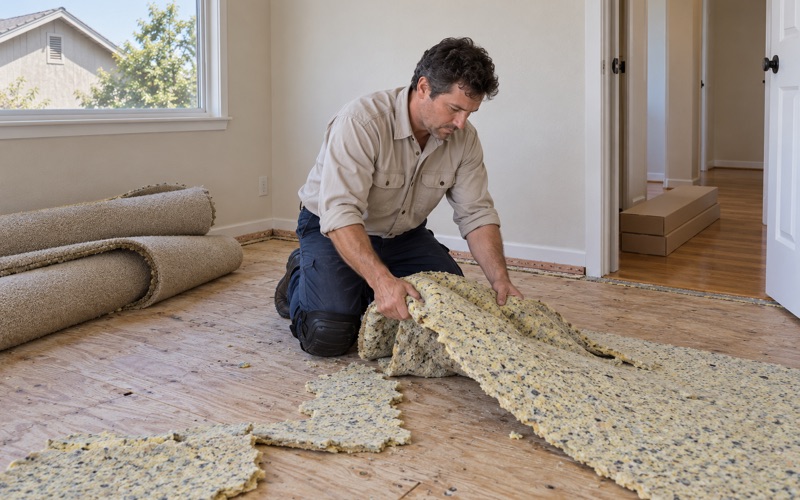
Cypress Wood Flooring has spent more than 20 years on wood-flooring in South Whittier and the neighboring towns, and a good share of the work here happens inside rental units rather than owner-occupied houses. That changes what a floor job has to produce. Besides a sound, well-finished floor, an apartment owner or a tenant often needs a clear written record of what was wrong, what we did, and what it cost.
We build that record into every rental job as a matter of routine. Before a board is pulled we photograph the room, take moisture readings, and note where the damage starts and stops. When the work is finished, the invoice separates repair from refinishing and lists each room, so the paperwork makes sense to someone who never saw the floor.
This page explains why that matters in South Whittier specifically. The short version is that the county has written processes for both sides of a rental, one for tenants who say a unit’s condition has slipped and one for owners who say their costs justify a larger increase, and floor work can end up as evidence in either.
South Whittier Rentals Under the County Ordinance
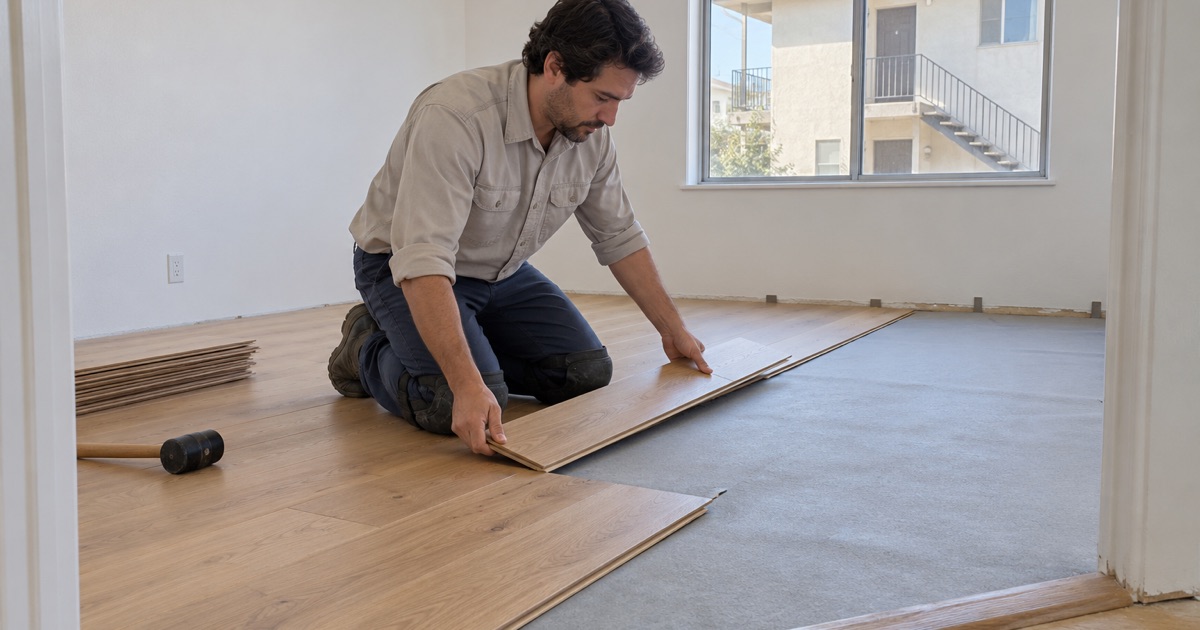
An unincorporated community with county rules
South Whittier is an unincorporated community in Los Angeles County, just south of the city of Whittier. There is no City of South Whittier, so there is no city council or city rent board. The Board of Supervisors governs the area, and it sits in Supervisorial District 4. For renters and landlords, that means the County’s Rent Stabilization and Tenant Protections Ordinance, found in Chapter 8.52 of the Los Angeles County Code, is the rule that applies.
The Department of Consumer and Business Affairs, usually shortened to DCBA, administers that ordinance. DCBA enforces the county’s rent stabilization rules and runs the Rent Registry, the online portal where owners register rental properties in unincorporated areas. When we talk with a South Whittier owner about a floor in an apartment, we assume those county rules are in the background, not a city ordinance from somewhere else.
What the housing stock looks like
South Whittier has about 15,690 housing units, and roughly 35 percent of occupied homes are rented. Most renters live in single-family houses, but 2,411 renter households, or 44.6 percent of all renters, live in buildings with five or more units. Those complexes are where we see the most repeated floor work: the same layout in unit after unit, each worn in its own way.
The buildings are also old. According to the latest five-year census estimates, 49.3 percent of the area’s units were built in the 1950s, and 84.3 percent were built before 1980. In an older apartment we expect earlier floor coverings under the current one, layers of adhesive, and subfloor repairs from past tenancies, and we price the job only after we have looked underneath.
Looking for wood-flooring closer to Santa Fe Springs? See Wood-Flooring in Santa Fe Springs.
When a Worn Floor Becomes a Written Notice
What the tenant application asks for
DCBA’s Tenant Application for Adjustment lets a tenant ask for a change in monthly rent when they believe the ordinance has been violated. Two of its claim types concern a unit’s condition: a reduction of housing services under Section 8.52.060(B)(3), and a landlord’s failure to maintain the habitability of the rental unit under Section 8.52.060(B)(2).
The form sets an order of steps. Before filing on either of those grounds, a tenant must first give the landlord written notice that identifies the issue and allows reasonable time to correct it. For habitability concerns, the tenant must also file a complaint with the appropriate enforcement agency before submitting the application to DCBA. The application itself must be filed within 180 days of when the tenant knew or should have known of the potential violation.
What we can and cannot say about a floor
Neither DCBA form mentions floors by name. Whether a lifted board, a soft spot, or a worn-through finish fits one of those claims is a question for DCBA and the parties, not for a flooring company. We do not give legal advice, and DCBA’s own materials say its forms are not legal advice either.
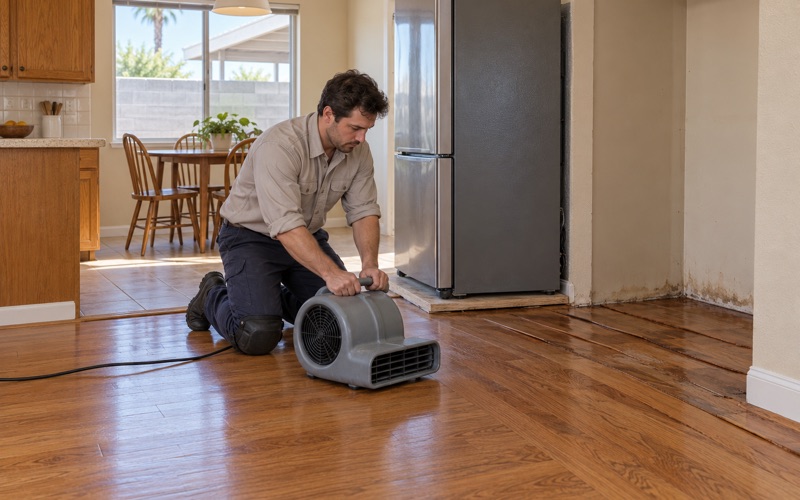
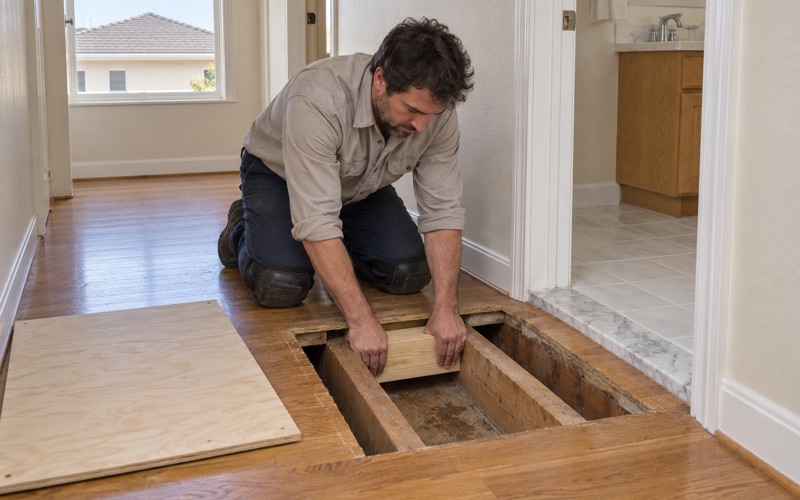
What we can do is describe the floor accurately. If a tenant or landlord asks us to inspect a unit, we record what we find: moisture content in the boards, whether a soft area near a tub or toilet traces to the subfloor, whether cupping follows a dishwasher line or a refrigerator water line, and how far the damage spreads. Those observations are dated, photographed, and written plainly.
Correcting the problem within the notice period
A notice gives the landlord reasonable time to correct the issue, and most owners we hear from want the floor fixed well inside that window. Speed only helps if the repair is right, though. A board replacement laid over a still-wet subfloor will fail again, and then both sides are back where they started.
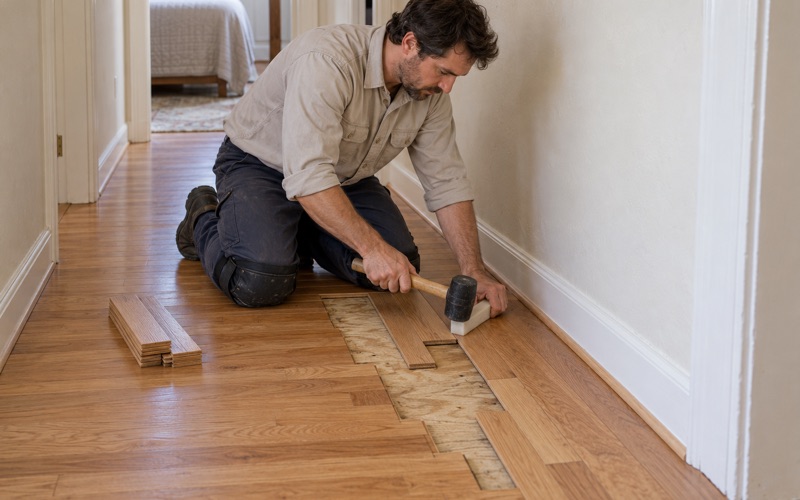
So we dry first and measure before closing anything up. Where a leak caused the damage, we wait until the plumber has repaired the line, confirm the readings with a wood moisture meter, and then weave in new boards or rebuild the section. The written readings go to the owner with the invoice, so the record shows the fix was more than cosmetic.
Repair Costs and the Fair-Return Application
Maintenance and repairs as documented expenses
The ordinance also gives owners a path. Under DCBA’s Landlord Application for Rent Increase, the landlord of a fully covered unit may ask for an increase beyond the standard annual amount in order to earn a fair and reasonable return. The landlord carries the burden of proving that need, and the supporting documents include expenses such as ongoing maintenance and repairs, alongside property taxes, insurance, and utilities.
That is where clean floor invoices earn their keep. We itemize by unit and by room, separate subfloor repair from finish work, and date each visit. An owner who hands DCBA a single lump-sum figure for flooring is asking a reviewer to guess what it covers; an itemized record answers the question before anyone asks it.
The cap and the prerequisites
The application has limits written into it. DCBA will not approve an increase that, together with any fair-return amount, raises rent by more than 3 percent over the previous twelve months, or 4 percent for a Small Property Landlord, or 5 percent for a luxury unit, unless DCBA determines otherwise. For comparison, the general allowable increase for July 1, 2026 through June 30, 2027 is 1.919 percent.
Before applying at all, every covered unit must be registered with DCBA and the registration fees must be current. The application compares expenses against a base year of September 2017 through August 2018, so older records matter as much as new ones. Owners who have kept floor invoices from those years are in a better position than owners who have to reconstruct them.
What the application does not cover
The landlord form states that it is not a substitute for the separate cost-recovery options in Section 8.52.070, and we have not reviewed that section, so we do not describe how it treats floors. The fees and costs of preparing the application itself also cannot be charged to tenants, and tenants must be served notice within five calendar days of filing.
Our part stays narrow. We supply accurate paperwork for work we actually did, and we leave decisions about which process to use to the owner and DCBA. Where a question turns on how the ordinance applies, we point people toward the county office described below.
Timing the Work and Finding Local Help
Between tenancies and while a unit is occupied
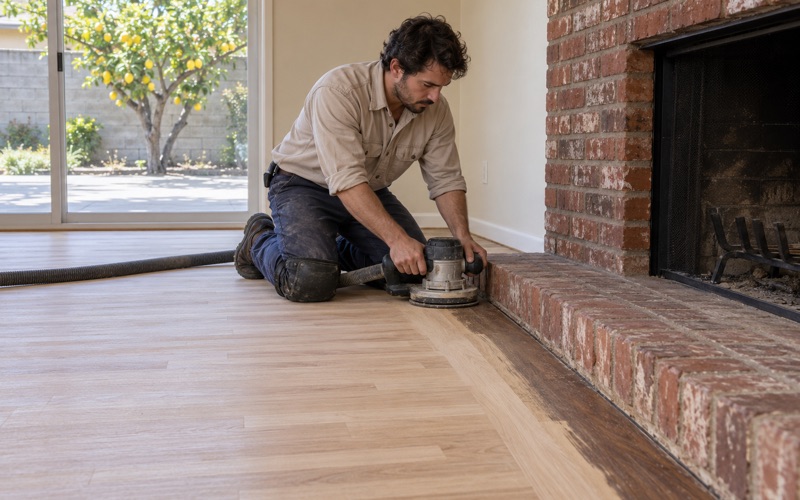
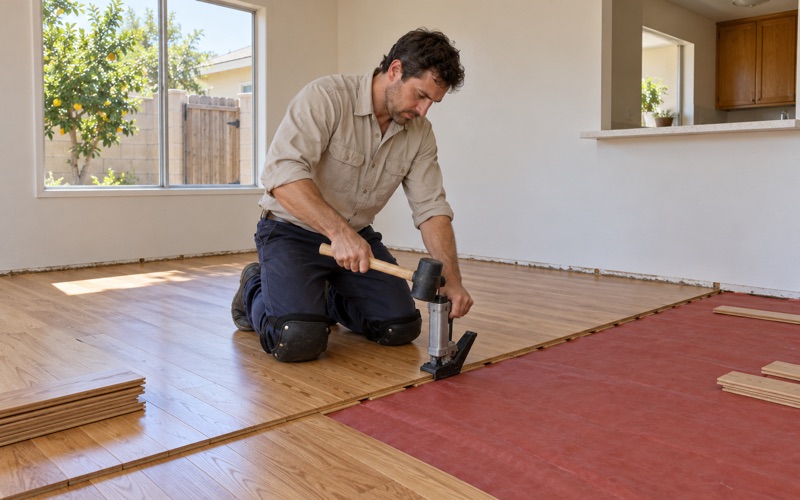
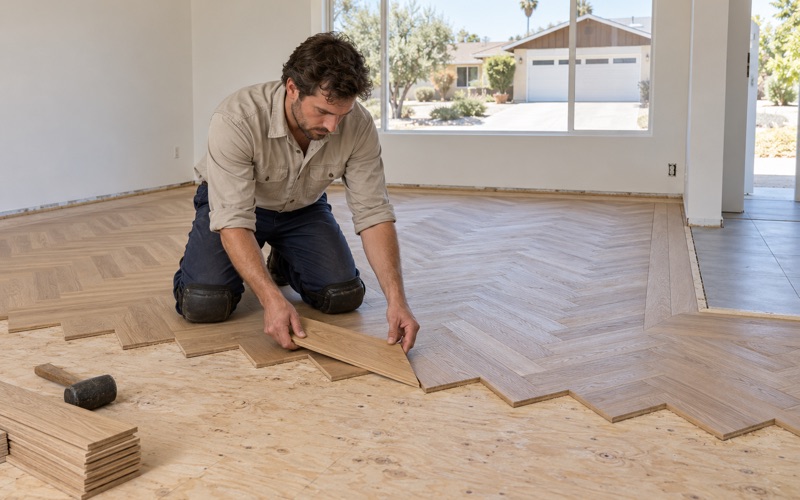
The easiest time to sand and refinish an apartment floor is between tenants, when the rooms are empty and the finish can cure without traffic. We use waterborne and oil-modified polyurethanes that meet the South Coast air district’s 275 g/L limit for wood coatings, and we give the owner a written cure schedule showing when furniture can go back.
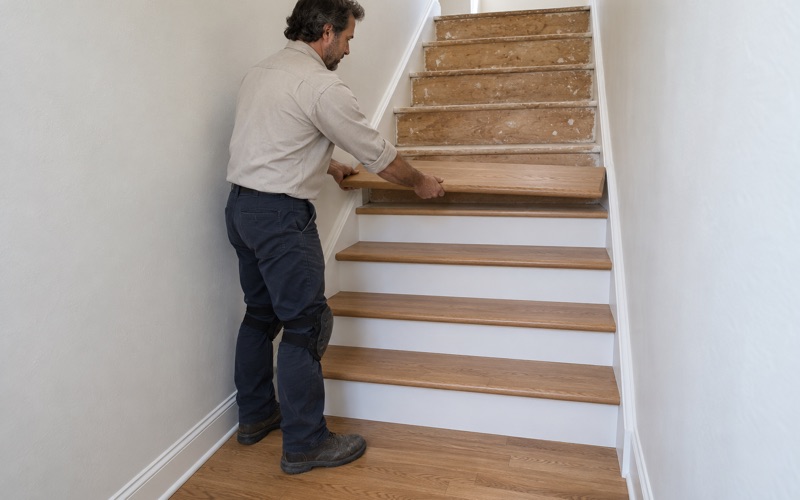
When a unit is occupied, we plan the job room by room so the household keeps a usable path through the home. The tenant gets the same written schedule, marking which room is closed on which day and when each can be walked on again. On a small repair, such as a board replacement near a sliding door, the disruption is often limited to one afternoon.
Older buildings need a careful start
Because most of South Whittier’s units predate 1978, we follow lead-safe work practices under the EPA Renovation, Repair and Painting rule when a job disturbs painted surfaces such as baseboards or door casings. Dustless sanding systems keep fine particles out of neighboring units, which matters in a shared building.
We also treat old floor tile and black mastic in pre-1980 units as an asbestos question before anything is scraped, sanded, or covered. A 9x9 tile under carpet in a 1950s apartment gets tested first, and the result goes into the same file as the moisture readings and photos.
The South Whittier Community Resource Center
DCBA has a local office close by: the South Whittier Community Resource Center at 10750 Laurel Avenue in Whittier. It serves residents on a range of consumer and housing matters, and it is the practical first stop for a tenant or owner with a question about how the rent ordinance applies to their situation.
DCBA’s Rent Stabilization Program can also be reached at (800) 593-8222. We are glad to walk through a floor with either party and put what we find in writing, but questions about notices, applications, and deadlines belong with the county. Getting the floor right and getting the paperwork right are separate jobs, and the best results come when each is handled by the right people.
- 20+ Years in Wood Flooring
- Moisture Readings in Writing
- Room-by-Room Cure Schedule