
Cypress Wood Flooring has performed subfloor repair for more than 20 years in Cypress, CA, serving surrounding cities including Los Alamitos, Hawaiian Gardens, La Palma, Stanton and Buena Park. We find and fix the soft spots, rot, squeaks and uneven sections under a floor, so the wood, tile or vinyl on top has a sound base to sit on.
A soft spot near a toilet, tub or sliding door is rarely a flooring problem on its own. It usually means water has been reaching the plywood subfloor for a while, and the wood has started to break down. Laying a new finish floor over that area without fixing it is the most common way a new floor fails early.
That is why we trace every soft spot to its source before pricing the floor above it. You get a clear explanation of what is under the surface, what caused it, and what the repair involves, before any decision about new flooring is made.
Signs the Subfloor Needs Attention
Soft or Bouncy Spots
A section of floor that flexes or sinks slightly when stepped on is the clearest sign of a subfloor problem. It is most common around toilets, where a failed wax ring lets water seep out with every flush, and in front of tubs and showers, where splash and failed caulk let water reach the edges.
Sliding glass doors are another frequent spot. Rain and irrigation water can enter at a worn threshold or failed flashing and soak the subfloor from the edge inward. The damage may extend well into the room before the finish floor shows any sign.
Squeaks and Movement
Squeaks often mean the subfloor has loosened from the floor joists, so it moves slightly as you walk and rubs against nails or the joist itself. In older houses, subfloor panels were often only nailed down, and those nails can work loose over decades.
Movement can also come from gaps between the subfloor and joists, from undersized or damaged framing, or from finish boards that have lost their grip on the fasteners. Diagnosing which one you have tells us whether the fix is a few screws or opening up the floor.
Uneven Floors and Visible Damage
Humps, dips and ridges can come from swollen panels, sagging joists or subfloor sections that were patched poorly in the past. Finish floors show these problems in different ways: tile cracks, wood boards gap or cup, and vinyl shows ridges along panel seams.
Stains, a musty smell or dark edges along a wall can point to moisture reaching the subfloor from a hidden source. We take moisture readings in the area to confirm whether the water is still active or left over from an old leak that has since been repaired.
Finding the Cause
Bathroom Leaks
In bathrooms, the common sources are a failed toilet wax ring, a leaking supply line, a cracked drain fitting, a failed shower pan or gaps in the caulk around the tub. Each one lets water reach the subfloor in a slightly different pattern, which helps us pinpoint the source.
We identify the likely cause and tell you which trade needs to fix it. Plumbing repairs must be completed before the new subfloor goes down, or the fresh plywood will soak up water and fail in the same way as the old.
Kitchens and Appliance Leaks
In kitchens, a leaking dishwasher supply line, refrigerator water line or sink drain can wet the subfloor under cabinets and along the toe kick. Because the water spreads under cabinets, the visible damage is often only a small part of the affected area.
We check under and around the appliance, take readings along the cabinet run and find the edge of the wet area. That determines whether the repair can stay in front of the cabinets or needs to extend beneath them.
Doors, Walls and Water Heaters
At sliding doors and exterior doors, water can come from a worn threshold, failed flashing or irrigation hitting the wall. Near water heaters and AC air handlers, a leaking tank, a relief valve or a clogged AC condensate line can wet the subfloor along a wall.
These sources are easy to overlook because the water enters from the edge. We check the wall base and any nearby utility closets so the repair addresses the real cause and does not leave the source active under a new floor.
How We Repair the Subfloor
Opening the Floor and Finding Sound Wood
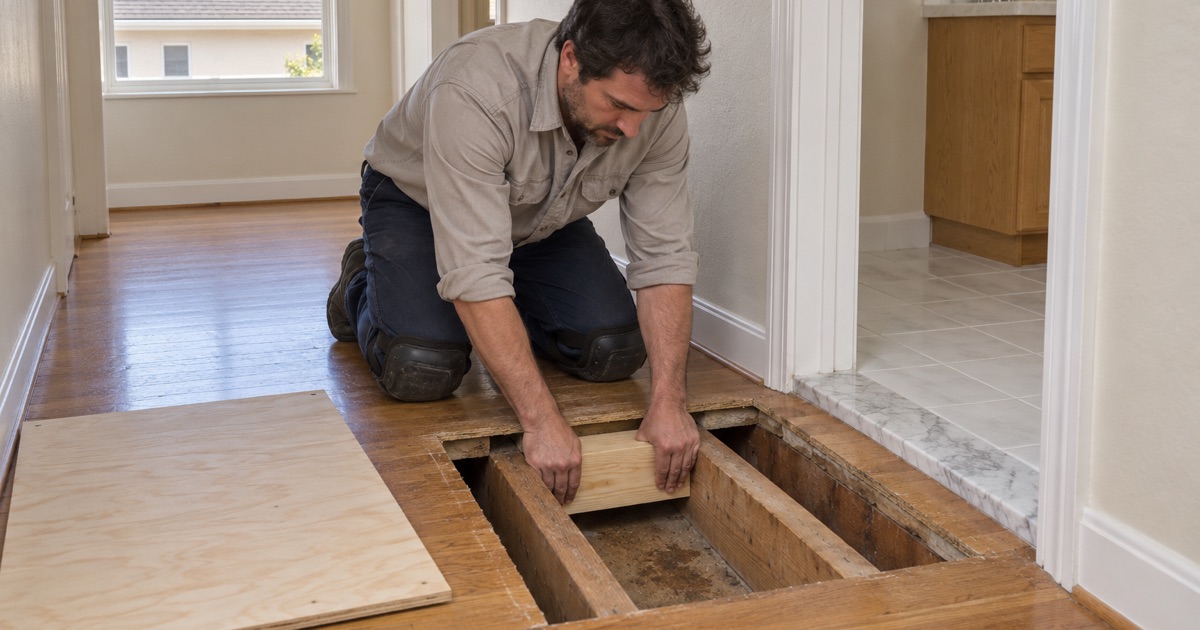
We remove the finish floor in the affected area, saving boards where they can be reused. We then probe the plywood subfloor for softness, take moisture readings and mark the boundary where the wood becomes sound and dry again.
The cut line is placed over floor joists wherever possible, so the new panel has full support on its edges. Cutting to the nearest convenient line instead of to a joist leaves an unsupported edge that flexes and eventually squeaks.
Replacing Panels and Reinforcing Framing
Damaged subfloor is cut out and replaced with new panels matched in thickness to the surrounding floor, glued and screwed to the joists. Where a floor joist has been weakened by rot or termites, we add blocking or sister a new member alongside it, or bring in a structural specialist when the damage calls for one.
We also check that the patch sits level with the surrounding floor. A slight lip where old and new meet will show through thinner finish floors, so we plane or shim as needed to keep the surface flat.
Drying, Treating and Protecting
If the framing is damp, we let it dry before closing the floor. Where water damage has left mold on framing, we recommend remediation by a qualified company. Around toilets and tubs, we make sure the new subfloor is protected and sealed before the finish floor goes back.
We also record what we found, with photos of the damaged panels, the moisture readings and the extent of the repair. If the damage came from a sudden plumbing failure, that record helps when you discuss the loss with your insurer, and it gives any future buyer a clear account of the work.
Termite and Beetle Damage Below the Floor
Drywood termites and powderpost beetles can weaken subfloor panels and framing without leaving much sign on the finish floor above. When we open a floor and find frass, galleries or small exit holes, we stop and recommend treatment by a pest professional before rebuilding.
After treatment, we replace wood that has lost its strength and reinforce framing where needed. Rebuilding over active insects would only feed the problem, so the order is always treatment first, then repair, then the finish floor.
Slabs and the Finish Floor Above
When the Slab Is the Subfloor
In houses built on a concrete slab, the slab is the subfloor. It can have its own problems: cracks, high and low spots, old carpet pad adhesive or black mastic, and patches left behind after a slab leak repair. We grind high spots and fill low ones so the new floor sits flat.
Before installing engineered wood over the slab, we test its moisture with a calcium chloride moisture test or an ASTM F2170 in-situ relative humidity test and record the readings. In pre-1980 houses, old black mastic is treated as an asbestos question until an asbestos survey says otherwise.
Reinstalling the Finish Floor
With the subfloor sound, we reinstall or replace the finish floor. Saved wood boards are woven back in with new ones where needed, and solid floors are sanded and refinished so the repaired area matches the rest of the room.
Finishes are legal in the South Coast air basin under the 275 g/L VOC limit of SCAQMD Rule 1113, and we give you a written schedule showing when the repaired area can be walked on and when furniture can return.
- 20+ Years in Wood Flooring
- Moisture Readings in Writing
- Room-by-Room Cure Schedule