Cypress Wood Flooring has spent more than 20 years on wood-flooring in Westminster and the neighboring cities, and a good share of that work lands in homes the owner does not live in. When a tenant moves out and the keys come back, the floor is usually the first thing an owner walks across and the hardest thing to judge. Scratches, gray patches near the sliding door and a soft spot by the tub all ask the same question: fix it, sand it, or start over?
We answer that question with readings and photos rather than a guess. Before we price anything we check what sits under the finish floor, meter the boards for moisture content, and write down what we find so the owner can compare options on paper. The goal is a floor that survives the next lease, priced so the decision makes sense for a rental.
This page is written for the owner-landlord in particular: someone renting out a house, a condo or a small building, deciding between tenants how much floor work the unit really needs.
Westminster’s Short Experiment With Rent Control
The local rules around a rental floor start with a piece of city history that surprises many owners. Westminster was founded in 1870 by Rev. Lemuel Webber as a Presbyterian temperance colony and incorporated in 1957, and for a few years in the 1980s it regulated rents.
What the 2019 Staff Report Found
On August 14, 2019, a staff report prepared by Deputy City Attorney Carrie A. Raven went to the City Council as File 19-208, titled Summary of Options for Rent Stabilization. It records that Westminster adopted a rent control ordinance in 1981 and that the ordinance was immediately challenged in court. Citing a Los Angeles Times article from March 1985, the report says the city was involved in 18 separate challenges to the ordinance’s constitutionality.
The report adds that about $1.5 million in rent proceeds was being held in a court-controlled trust account during that fight. After three councilmembers were elected in November 1984 on a platform of repeal, the ordinance was repealed in March-April 1985. At that point it was the only rent control ordinance left in Orange County.
Since 1985, No Local Rent Controls
The sentence owners tend to remember is the plainest one in the report: since 1985 there have been no rent controls in Westminster. The 2019 report itself recommended only that the council accept it for discussion, and it did not propose a new ordinance.
That history matters to floor work in a practical way. With no local rent board in the picture, a floor decision in a Westminster rental is not shaped by a city rent formula or a local approval step. It is shaped by the condition of the unit, the length of the next lease and the state rules that apply everywhere in California.
Looking for wood-flooring closer to Midway City? See Wood-Flooring in Midway City.
Renting in Westminster Under State Rules
The same staff report walks through the state framework that remains when a city has no rent ordinance of its own. We are floor people, not attorneys, so we describe that framework only as background and send legal questions to the owner’s own counsel.
Costa-Hawkins and the Houses Most Owners Rent Out
As the report summarizes the Costa-Hawkins Rental Housing Act, single-family homes, condominiums and townhomes are exempt from local rent control, and so are units built after 1995. In 2019 the report also listed AB 1482 as proposed state legislation; it later became the California Tenant Protection Act, which applies statewide.
For many owners we meet, the practical point is simple: the rules around the tenancy come from Sacramento, and the floor decision is theirs to make on condition and cost. Questions about deposits, normal wear and tear or rent belong with a lawyer, and we keep our reports focused on what the floor shows.
Who Rents, and What They Rent
Census figures put 13,112 of Westminster’s 28,150 occupied units in renter hands, close to half the city. Of those renter households, 3,756 rent detached houses, which is the group most likely to call a flooring crew directly rather than through a management company.
The rest of the rental stock spreads across very different buildings, from 1,909 households in three- and four-unit buildings to 2,276 in buildings of fifty units or more. A small owner of a fourplex and the owner of a rented three-bedroom house face different floor questions, and we price them that way.
Maintenance Stays With the Owner
Westminster’s nuisance chapter, as excerpted in search results, says every owner of real property remains liable for maintaining it regardless of any contract or agreement with a third party. We read that as a reminder rather than a legal opinion: a floor that has become unsafe, with loose boards or a spongy subfloor, is the owner’s problem to address whoever manages the lease.
Floors in Westminster’s Rented Houses and Apartments
Westminster’s housing stock is older than many owners assume. About 75.8 percent of units were built before 1980, and the 1970s are the largest single building decade at 27.3 percent of units. That age profile shapes what we find when the carpet comes up in a rental.
What Turns Up Under Carpet and Old Tile
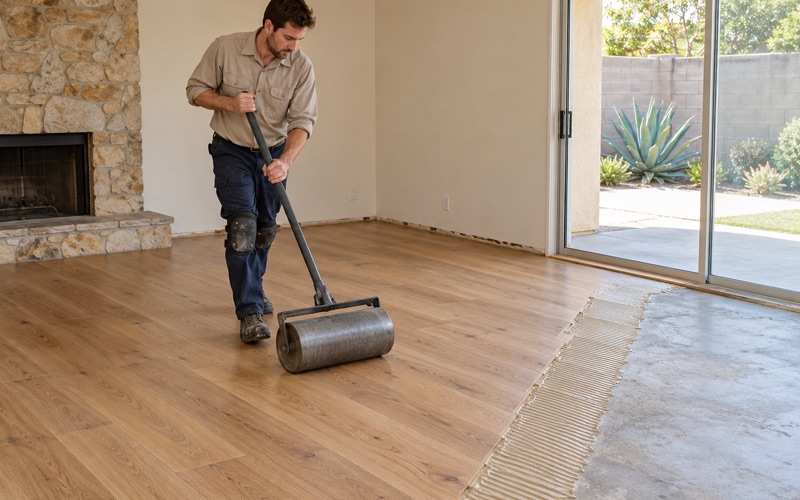
In a house or unit from that era, we check what is under the carpet before quoting, because it could be oak strip flooring, a plywood subfloor or a concrete slab, and each leads to a different job. Carpet tack strip, carpet pad adhesive and old flooring staples all have to come out cleanly before anything new goes down.
Old floor tile deserves more care. In pre-1980 buildings we treat 9x9 floor tile and black mastic as an asbestos question before anything is sanded, scraped or covered, and an asbestos survey comes first when the material is suspect. In pre-1978 housing we follow the EPA Renovation, Repair and Painting rule and lead-safe work practices as well.
Wear That Tenants Leave Behind
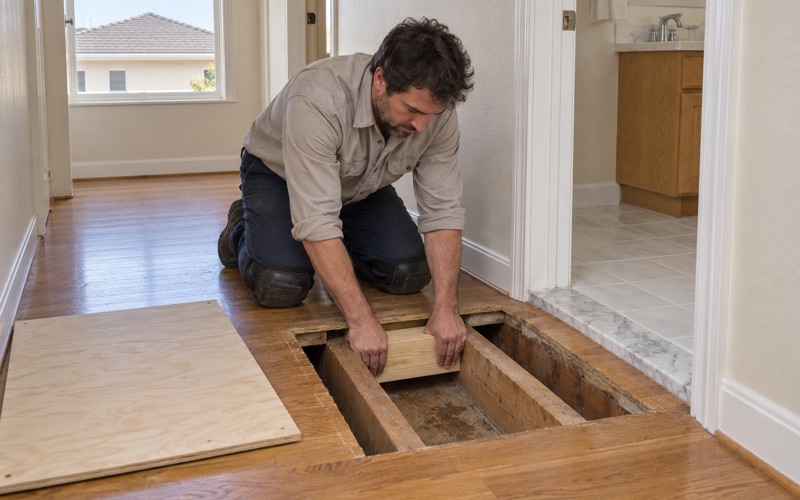
Rental floors collect a recognizable set of problems. Pet urine stains darken oak, furniture grinds the finish at doorways, and a leaking refrigerator water line or dishwasher supply line can leave cupping in the boards nearby. Soft spots near toilets, tubs and sliding doors often point to a subfloor problem, and we trace them before any finish floor is priced.
When water is the cause, we rebuild after drying and record moisture readings and photos an insurance adjuster can use. Where a slab leak was involved, we wait until the plumber has repaired or rerouted the line, then plan the access opening before any boards are cut.
Repair, Refinish or Replace Between Tenants
The turnover window is short, and every week a unit sits empty costs rent. That makes the choice between repair, refinishing and replacement a scheduling decision as much as a cost decision.
When a Repair Is Enough
If the damage is local, a board replacement or weave-in repair can restore a room without touching the rest of the floor. We match species and width, blend the finish, and leave the tenant-facing rooms looking consistent. For a house leased for another year or two, a sound repair is often the most sensible spend.
A screen and recoat is the other light option. When the finish is worn but the wood itself is unmarked, abrading the surface and applying a fresh coat renews the wear layer in a day or two of work, with far less downtime than a full sanding.
When Refinishing Makes More Sense
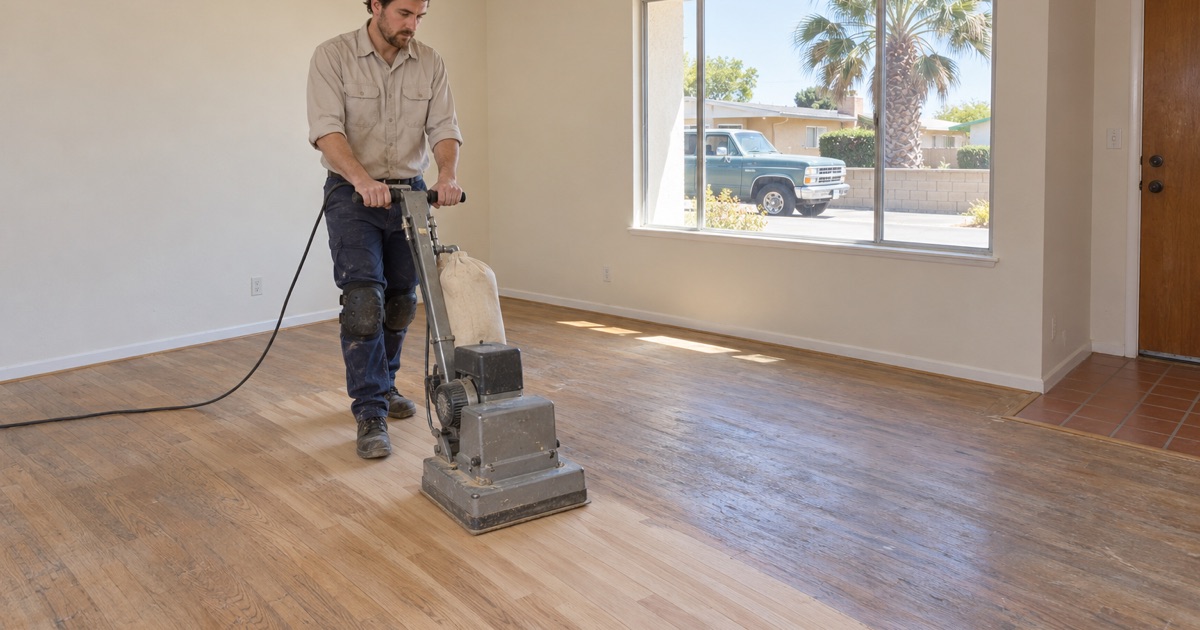
Deep scratches, gray oak around entries or an orange oak cast that makes a rental look dated call for a full sand and refinish. We run a proper grit sequence with a drum sander, edger and orbital sander, and use a dustless sanding system so an occupied duplex next door is not coated in dust.
Finishes come from products legal to apply in the South Coast air basin under the SCAQMD Rule 1113 limit of 275 g/L for wood coatings. For rentals, a waterborne polyurethane in a satin sheen level tends to hide daily wear and cures quickly enough to fit a tight turnover.
When Replacement Is the Honest Answer
Some floors are past saving: engineered veneer delamination, repeated sanding that has worn through the wear layer, or water damage that reached the subfloor. For those we price replacement, and on a concrete slab we test moisture before engineered wood goes down, using a calcium chloride moisture test or an ASTM F2170 in-situ relative humidity test and writing the readings down.
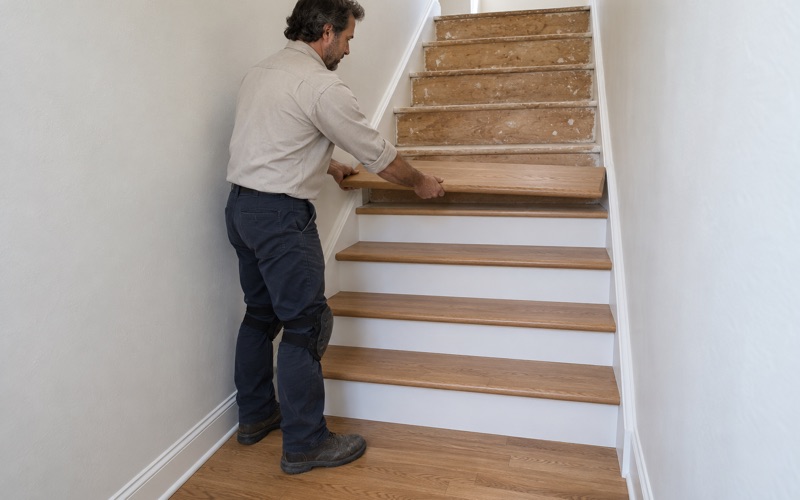
For a rental, we steer owners toward durable species with a strong Janka hardness rating, such as white oak or hickory, and prefinished boards that shorten the schedule. Carpeted stairs converted to hardwood are priced per tread and riser, so the stair work shows as its own line.
Planning Rental Floor Work in Westminster
A floor job in a rental goes smoothly when the plan is written before the old tenant is fully out. We walk the unit, take readings, and hand the owner a room-by-room plan with a written cure schedule.
Fitting the Turnover Calendar
That schedule shows when each room can be walked on and when furniture or appliances can return, which lets an owner line up cleaning, painting and showings around the floor rather than guessing. On a multi-unit building we can stage the work so neighboring units stay livable.
Condos and Townhomes With an Association
Many rented condos and townhomes sit inside an association, and the CC&Rs may say something about floor changes, especially hard flooring over living space. We handle those jobs with the association’s rules in mind, including when an interior change needs no approval and when the governing documents send it to an architectural review committee.
Getting Started
If a Westminster rental is between tenants, or about to be, call us before the move-out inspection. An early look at the floor gives an owner time to choose between repair, refinishing and replacement on the evidence, rather than on whatever fits the last week before the next lease begins.
- 20+ Years in Wood Flooring
- Moisture Readings in Writing
- Room-by-Room Cure Schedule