
Cypress Wood Flooring has installed wide plank hardwood flooring for more than 20 years in Cypress, CA, serving surrounding cities including Los Alamitos, Hawaiian Gardens, La Palma, Stanton and Buena Park. We also install herringbone and chevron patterns, from a single entry hall to open living areas, in solid or engineered wood.
Wide boards and pattern layouts make a strong statement, and they reward careful preparation more than any other floor style. A wide plank shows every hump in the subfloor and moves more with humidity. A herringbone or chevron floor shows every layout mistake from the doorway. Both need planning before the first board is cut.
We start by checking the subfloor, whether plywood or a concrete slab, and taking moisture readings. Then we lay out the rooms on paper, deciding where the pattern starts, how it meets walls and doorways, and how wide boards will fall across the space, so the finished floor looks intentional throughout.
Wide Plank Hardwood
What Counts as Wide
Traditional strip flooring in many older homes uses narrow boards. Wide plank flooring uses noticeably broader boards, and at the widest end single planks cover a large part of the floor on their own. Fewer seams give a calm, open look that suits both modern and farmhouse styles.
Board width also changes how a room feels. Wide planks make a large room feel settled and a small room feel larger, while mixed widths add a hand-crafted, older character. We bring samples so you can compare widths in your own light and space.
Solid or Engineered for Wide Boards
A wide solid board moves more with humidity than a narrow one, so any seasonal gap or cupping is more visible. Engineered wide planks, with a real wood wear layer over a stable engineered core construction, move far less, which is why they are often the better choice for wide widths.
Engineered planks are also the usual choice over a concrete slab. Solid wide planks can work over a plywood subfloor with careful acclimation and fastening, often combining nails with adhesive to limit movement. We recommend based on your subfloor and how much natural character you want to live with.
Species and Grade in Wide Widths
White oak is the most popular species for wide plank flooring, prized for its grain, stability and range of finishes. Hickory brings bold variation and high hardness on the Janka hardness rating, while maple offers a smooth, bright look. Rustic grades show knots and color changes that suit wide boards well.
Because wide planks show more of each board, grade choice has a bigger effect on the final look than it does with strip flooring. We open cartons and lay boards out before installation, mixing them so no area ends up with a cluster of the same color or knots.
Herringbone and Chevron Patterns
Herringbone Layout
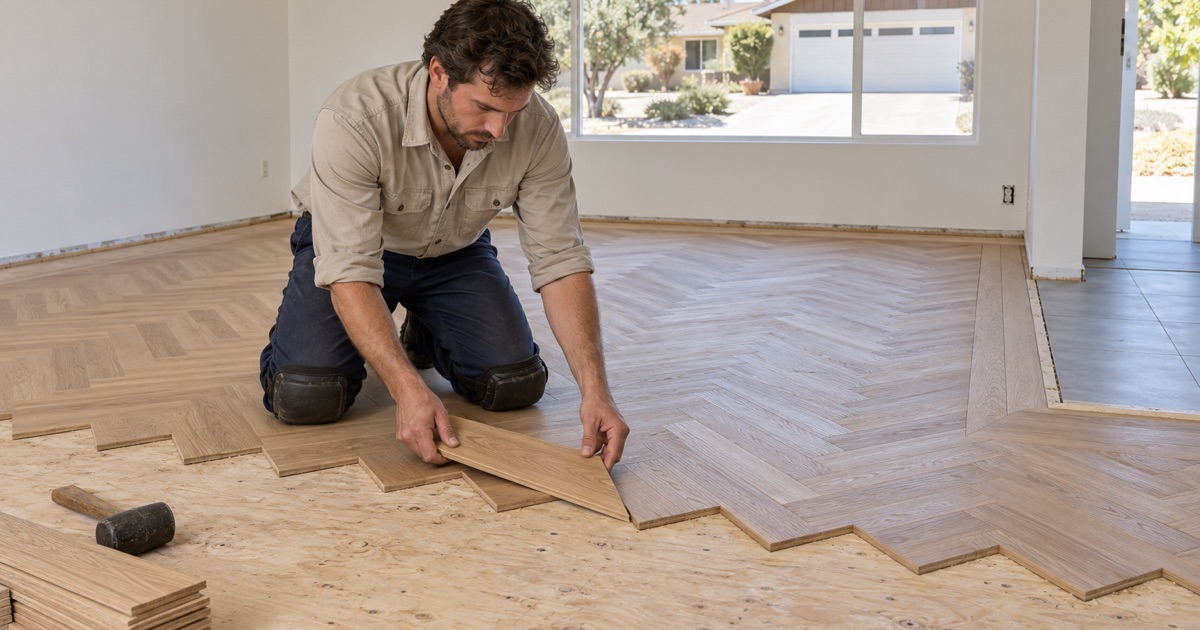
A herringbone pattern uses rectangular boards laid at an angle in a staggered zigzag, with the end of each board butting the side of its neighbor. It has a classic European look and draws the eye along the length of a room or hallway, which makes it popular for entries, halls and dining rooms.
The starting line is everything. We snap a center line along the room’s main view, usually from the front door or the main entry to the room, so the pattern runs straight and symmetrical where people look first. Rooms that are out of square need extra attention so the pattern stays true.
Chevron Layout
A chevron pattern looks similar but uses boards with angled ends that meet in a sharp point, forming a continuous V down the room. It reads as cleaner and more modern than herringbone. Chevron boards are made for that pattern, so the angle is set by the product rather than cut on site.
Borders, Transitions and Edges
Pattern floors need a plan for their edges. Some rooms are finished with a border of straight boards around the perimeter, which frames the pattern and simplifies the cuts at the walls. Others run the pattern right to the baseboard, with every edge piece cut to fit.
Where a pattern floor meets another floor, we plan the transition so it looks deliberate, using a threshold, a straight border board or a reducer strip. Doorways are laid out so the pattern flows into the next room or stops cleanly at a defined line.
Preparing and Installing Wide and Pattern Floors
A Flat, Dry Subfloor
Wide boards and pattern floors reveal any unevenness underneath. We check flatness with a straightedge and correct high and low spots before installation, sanding plywood seams or grinding and patching a slab. A small dip that disappears under a narrow strip floor can show clearly under a wide plank.
Moisture testing matters just as much. On a slab, we run a calcium chloride moisture test or an ASTM F2170 in-situ relative humidity test and record the readings. Over plywood, we measure the moisture content of the subfloor and the flooring with a wood moisture meter before installation.
Acclimation and Installation Method
Wide planks and pattern blocks are acclimated according to the manufacturer and NWFA installation guidelines, then installed using the method suited to the substrate. That may be glue-down installation on a slab, nail-down installation over plywood, or a combination for wide solid boards.
Pattern floors are usually glued or glued and pinned, block by block, working outward from the center line. It is slower than a straight lay, but it keeps the pattern tight and prevents the gradual drift that can pull a herringbone out of line across a large room.
Finishing Pattern and Wide Floors
Site-finished pattern floors are sanded with extra care, because the grain changes direction from one board to the next. We finish with an orbital sander to avoid visible cross-grain scratches, then apply stain and finish. Prefinished options skip sanding entirely and are available in many wide plank and herringbone products.
Every site-applied finish we use is legal in the South Coast air basin under the 275 g/L VOC limit of SCAQMD Rule 1113, and we give you a written cure schedule that shows when each room can be walked on and furnished.
- 20+ Years in Wood Flooring
- Moisture Readings in Writing
- Room-by-Room Cure Schedule